


Giuseppe Bonito
Castellammare di Stabia, Naples 1707 - Naples, 1789
The Painter's StudioOil on canvas, 66 ¹/₈ x 92 ¹/₂ in (168 x 235 cm)
- PROVENANCE
- LITERATURE
- EXHIBITIONS
- DESCRIPTION



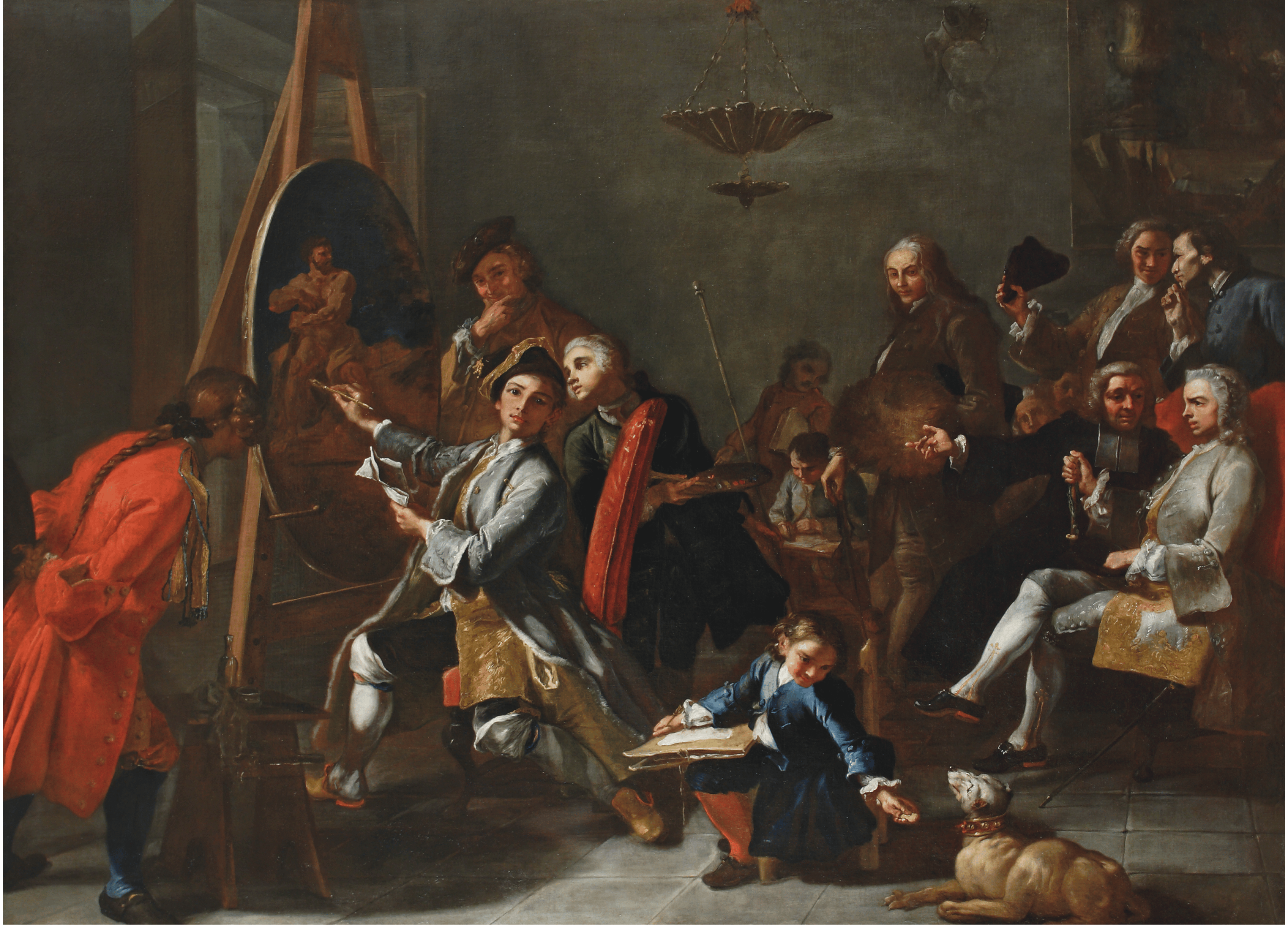


Fig. 1
PROVENANCE
Collection of William Henry Waddington (1826-1894), no doubt acquired between 1850 and 1880, Château de Saint-Léger-du-Bourg-Denis (near Rouen); by descent to 1939; hidden in 1940 in the family factory at Saint-Rémy-sur-Avre, near Dreux; by descent; 2012, Geneva, private collection.
LITERATURE
- Bernardo De Dominici, Vite de’ Pittori, scultori ed architetti napoletani, annotated edition in 3 vols., ed. Fiorella Sricchia Santoro and Andrea Zezza, Naples, 2008, II, p. 1354 ;
- Véronique Damian, A Selection of Paintings from Galerie Canesso, Paris, cat. exp. New York, Didier Aaron Gallery, 20 janvier – 4 février, 2011, pp. 22-27 ;
- Achille Della Ragione, Giuseppe Bonito. Opera completa, Naples, 2014, p. 7, fig. 10;
- Nicola Spinosa, ed., with the collaboration of Carla Valerio, Neapolitan Painting. The Carla and Francesco Valerio collection, Florence: Forma, 2015, pp. 120, 126-127 ;
- Achille Della Ragione, Nuove notizie ed aggiunte a Giuseppe Bonito, Naples, 2016, p. 7, fig. 11.
EXHIBITIONS
A Selection of Paintings from Galerie Canesso, Paris, New York, Didier Aaron Gallery, 20 janvier – 4 février, 2011.
DESCRIPTION
Related works
- A bozzetto auctioned by Sotheby’s in London, published by Bologna and Spinosa without sale date or dimensions: see Ferdinando Bologna, Gaspare Traversi nell’illuminismo europeo, Naples, 1980, pp. 50, 77-78, note 110, fig. 20; Nicola Spinosa, Pittura napoletana del Settecento, dal Barocco al Rococò, Naples, 1993, p. 169, no. 289, fig. 356, with earlier literature.
- A copy after the bozzetto, containing numerous variants with regard to the painting but also including others relating to the bozzetto: see Ferdinando Bologna, Gaspare Traversi nell’illuminismo europeo, Naples, 1980, pp. 50, 77-78, note 110, figs. 20-22. This copy has a pendant: a copy of a bozzetto (untraced) for The Huntsmen’s Rest, the composition that accompanied The Painter’s Studio from the start, recently rediscovered and purchased by the Museo di Capodimonte, Naples (see Tiziana Scarpa, in Ritorno al Barocco. Da Caravaggio a Vanvitelli, exh. cat., Naples, Museo di Capodimonte, 12 December 2009 – 11 April 2010, p. 316).
The rediscovery of this documented composition by Giuseppe Bonito – ambitious in scope as it is in concept – provides new evidence of the artist’s creative process, far more varied than one would imagine from his firmly-founded reputation as portrait painter. The Lives by Bernardo De Dominici, published in Naples between 1742 and 1745, conclude with an account of the painter Francesco Solimena (1657-1747) and his pupils, among whom Giuseppe Bonito appears prominently. Indeed the biographer underlines his special talents in portraiture and how this brought him to the attention of the Bourbon monarchs through their Secretary of State in Naples, the marquis José Joaquin de Montealegre, Duke of Salas, an influential patron and artistic councillor to the King. Salas soon employed the young Bonito in his household. The court of Carlos and Maria Amalia de Bourbon thus found itself with a rich supply of artists from the circle of the ageing but indefatigable Solimena – painters who could fulfil its expectations as regarded both decoration and indispensable official portraits, and those of the numerous royal descendants.
Apart from his oeuvre in portraiture, the young Bonito was active as history painter, especially of religious subjects for Neapolitan churches, and his work in both these fields ensured a successful career during the 1730s, as proved by his repeated participation in the Feast of the Corpus Domini, known as the Feast of the Four Altars, between 1735 and 1740. The event was held annually in Naples in the Largo di Palazzo, now called the Piazza del Plebiscito.
According to De Dominici, the exhibition involved the presentation of genre scenes in a large public forum. We are now in a position to have a more precise idea of what was involved, as the pictures have reappeared in recent years, one by one. The first two of these paintings cited were The Schoolmaster and The Sewing Mistress (private collection)1. The subjects exhibited in the year that followed were The Poet (Madrid, collection of the Duke of Remisa) and The Concert (Norfolk, Chrysler Museum of Art), erroneously described by the biographer as a single composition2.
Again according to De Dominici, The Painter’s Studio functioned as a companion piece to The Huntsmen’s Rest (of identical dimensions), which also reappeared a few years ago and was acquired by the Capodimonte Museum in Naples3.
Notwithstanding his lengthy description, De Dominici does not inform us about either patronage or ownership. Years later the painting reappeared in France, no doubt acquired during the second half of the nineteenth century, in the collection of the Waddington family, then at the height of its success. The brothers Richard (1838-1913) and William Henry (1826-1894) were actively involved in French politics, and their father Thomas founded a cotton manufacturing company at Saint-Rémy-sur-Avre; Richard succeeded him as director of the factory. William Henry, who was Prime Minister of France in 1879, was also an archaeologist.
Here the scene takes place within a workshop, and though the painter is at his easel, his pose is clearly that of a performer, and he is dressed accordingly. At the far right, we see an important visitor, a gentleman seated with crossed legs. His right hand rests on a cane with an elaborate handle, and he bears a sword on his left – a detail prompting De Dominici’s description of him as a “military” man. A number of people wait on him, including a cleric who points out the subject while others show deferential respect – raising a hat, enjoining silence – all of them attentive to the work of art as it is created. We can also easily recognize the older man dressed “alla spagnuola” in the words of the biographer, thanks to his voluminous bearskin sleeve. The artist has passed his palette and stick to a young assistant while handling a crayon holder, and his left hand holds a folded paper with a drawing of what is being reproduced. The sheet has a coloured version of the oval composition. The light-hearted, casual attitude of the artist whose gaze meets ours is accompanied by a nice turn of the hips and shoulders. He seems to be indicating a detail of the figure of Hercules resting on his club, his head turned to the right, sketched in brown grisaille. While the subject may recall the Farnese Hercules (now in the Archaeological Museum, Naples), the drawing is unrelated, since the celebrated ancient statue has a standing pose. Young apprentices assist their master, or engage in drawing, and the one in the foreground is distracted by a dog, to whom he offers a biscuit. Two other standing figures on the left side of the composition are shown closely examining the canvas. This group of spectators – no doubt real portraits, as De Dominici states – suggests that this was an important commission, and that the principal figure dressed in white and yellow is the patron; the Herculean iconography could thus be an allusion to his personal glory, or that of his family. The workshop is truly a performance space: on the right, a painting is seen on the wall (one can guess at its subject, a still life), earthenware jugs hang from a nail, and a large lamp is at the centre, although the room is lit by the open window at left.
The question of whether the painter depicted here is Bonito remains open. The Self-Portrait in the Uffizi Gallery in Florence gives the impression of an artist who is still nimble, but aged4. Unfinished at Bonito’s death, it was given to Grand Duke Pietro Leopoldo de’ Medici by the painter’s heirs, and it is thus hard to say whether the figure in our picture is Bonito; it could be a symbolic representation.
During the same period as that of our canvas, the artist once again treated the subject of the painter’s studio, producing a work of grand dimensions (Naples, Museo e Real Bosco di Capodimonte) in which an artist – whose facial features are quite distinct from those of our figure – is represented in a moment of relaxation, seated at a table and surrounded by musicians5.
Before its rediscovery, the painting was known through a bozzetto and a copy of that sketch, although both vary from the final composition in numerous ways (see Related works).
Like The Huntsmen’s Rest, our painting can be dated to about 1738/1740, and in any case not before that period, since in 1741 he signed and dated The Turkish Embassy to the Neapolitan Court (Madrid, Prado Museum), whose dense chromaticism is also found in our canvas. These are all examples of the style which was taking shape in these years, and which looked ahead to his future success. In 1751, Bonito was named Court Painter to the Bourbons, which led to other appointments: in 1755 he became director of the Accademia di Belle Arti in Naples, an office he held for the rest of his life, and two years later he took up the directorship of the Royal Neapolitan Tapestry Works, becoming Royal consultant for every decorative project involving painting. From 1752 onwards he was a member of the Academy of Saint Luke.
Notes
1 - Federica De Rosa, in N. Spinosa, ed., Gaspare Traversi: napoletani del’700 tra miseria e nobiltà, exh. cat., Naples, Castel Sant’Elmo, 13 December 2003 – 14 March 2004, pp. 202-203, nos. C5a, C5b: “one can also put forward a hypothetical date for these canvases, which cannot have been painted later than 1736”.
2 - Nicola Spinosa, Pittura napoletana del Settecento, dal Barocco al Rococò, Naples, 1993, p. 169, no. 293, figs. 357-358.
3 - Nicola Spinosa, in Francesco Porzio, ed., Da Caravaggio a Ceruti. La scena di genere e l’immagine dei pitocchi nella pittura italiana, exh. cat., Brescia, Museo di Santa Giulia, 28 November 1998 – 28 February 1999, pp. 352-353; Federica De Rosa, in Gaspare Traversi (cited in note 1), pp. 204-205, no. C6; Tiziana Scarpa, in Ritorno al Barocco. Da Caravaggio a Vanvitelli, exh. cat., Naples, Museo di Capodimonte, 12 December 2009 – 11 April 2010, p. 316. De Dominici’s description goes into great detail: “In the year that followed, he exhibited two large pictures, with full-length smaller than life-size figures. In one of these he represented a painter at work before an easel, with various pupils shown drawing. Many figures observe him as he paints, including, principally, a military gentleman seated on a chair with his legs stretched out, observing the painting with the closest attention, and, thus composed, balancing the figures around him. Also, an older man dressed in the Spanish style, with white hair and a great bearskin muff to warm his hands, certainly an impressive figure; and most of these numerous persons were painted from life. The companion painting represented young men carrying guns who are enjoying a hunt in the countryside, seen merrily joking with some peasant women they have met. These pictures, too, earned unanimous praise from the public.” (see Literature).
4 - Gli Uffizi. Catalogo generale, Florence, 1980, p. 816, no. A130 (oil on canvas, 82 x 63.5 cm; the painting entered the Uffizi in 1789 upon the death of the artist, who left it unfinished), and, most recently, Wanda Romano, in Alla corte di Vanvitelli. I Borbone e le arti alla Reggia di Caserta, exh. cat., Reggia di Caserta, 4 April – 6 July 2009, p. 135.
5 - Nicola Spinosa, Pittura napoletana del Settecento, dal Barocco al Rococò, Naples, 1993, p. 169, no. 293, fig. 356 (127 x 178 cm).
