


La marquise de Grollier; née Charlotte Eustache Sophie de Fuligny Damas
Paris, 1741 - Épinay-sur-Seine, 1828
46 painted buttons (28 large and 18 small, resp. 4 cm and 2 cm Ø)on ivory backed with mother-of-pearl (with shanks for sewing), under glass.
- PROVENANCE
- LITERATURE
- EXHIBITIONS
- DESCRIPTION



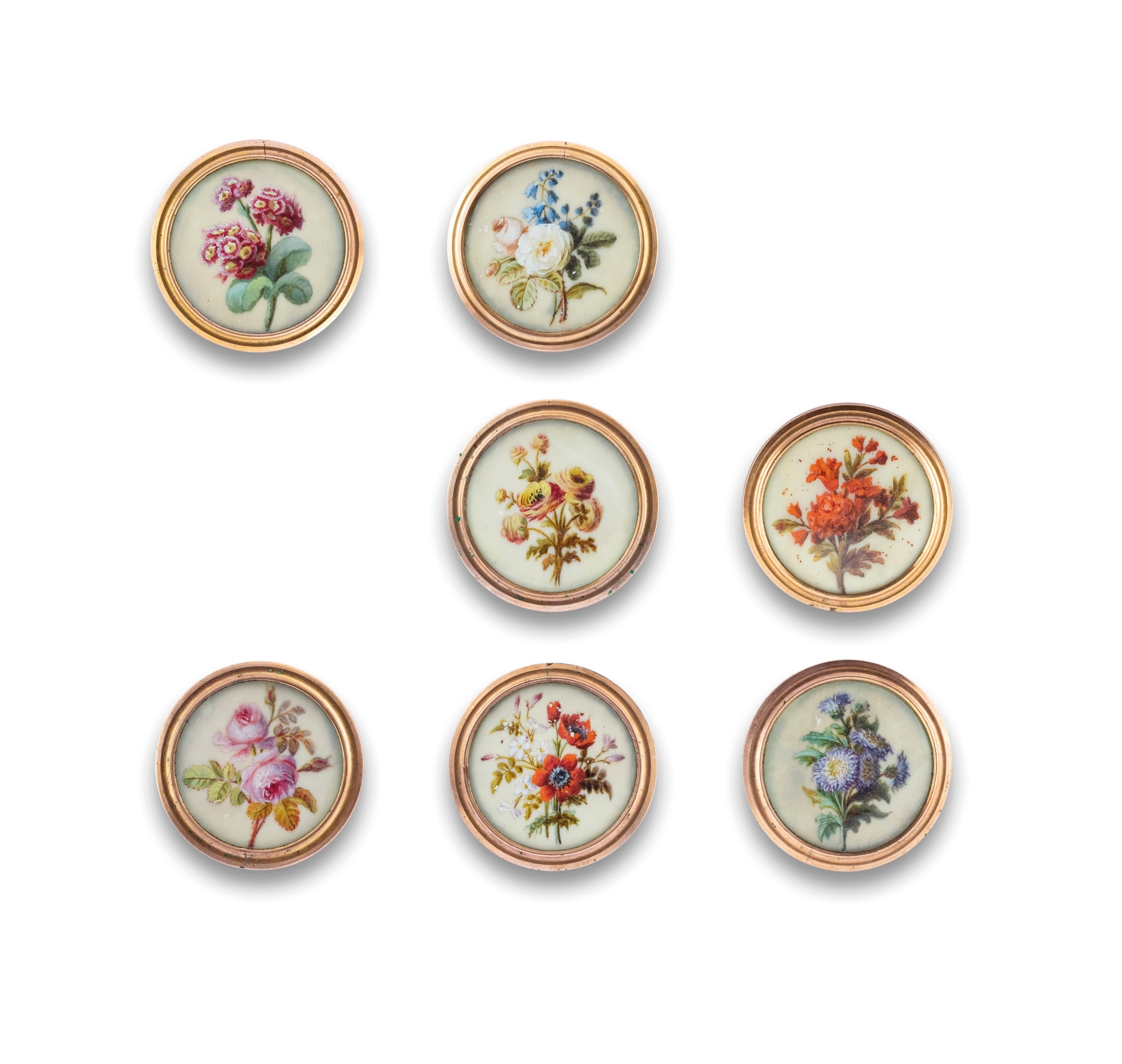


Fig. 1
PROVENANCE
Collection of the Marquise de Grollier, bequeathed to her daughter, Alexandrine Claudine de Grollier (1763-1849), who married Benoît Maurice François, Marquis de Sales (1760-1797) in 1781; their daughter Pauline Françoise Joséphine de Sales (1786-1852), Baronne de Roussy; her son, Eugène François Félix Joseph de Roussy de Sales (1822-1915), Château de Thorens, Thorens-Glières (Haute-Savoie); his son, Comte François-Maurice de Roussy de Sales (1897-1945), in the same château; his son, Comte Jean-François Roussy de Sales (1927-1999), likewise; collection of his heirs, 1999-2025.
LITERATURE
Véronique Damian, L’art au féminin. Portrait de la marquise de Grollier (1741-1828) par Élisabeth Louise Vigée Le Brun (1755-1842), exh. cat., Paris, Galerie Canesso, 13 September – 19 October 2018, pp. 16-19.
EXHIBITIONS
- L’art au féminin. Portrait de la marquise de Grollier (1741-1828) par Élisabeth Louise Vigée Le Brun (1755-1842), Paris, Galerie Canesso, 13 September – 19 October 2018;
- Végétal – L’École de la beauté, ed. by Marc Jeanson, Paris, Palais des Beaux-Arts, 16 June – 4 September 2022
DESCRIPTION
The late eighteenth century was the golden age of the button: it reflected who one was. Creativity and diversity were expressed through buttons, which became a medium for historical events, technical innovation, and states of mind; they could evoke love or friendship; in short, they reflected the world within a tiny space – that was their challenge!1 In the case of the Marquise de Grollier, these buttons decorated with botanical motifs, painted on ivory with mother-of-pearl backing, reveal a special side of her output and her enduring passion for flowers. She adapted these cherished motifs to two small-scale circular formats, which in turn disseminated her artistry. These buttons are precious evidence of how sheexplored painting in various media, both large and small, and they have remained in the family of the Marquise de Grollier to this day.
All the floral species depicted here are identifiable, sometimes appearing together on the same button (cornflowers and narcissus on one of them, for example). The variety of colours and fidelity of description would indicate that the Marquise painted directly from nature rather than from engraved plates, though the mode of representation evokes such prints.
Even if large buttons were worn on frock coats – small ones being reserved instead for sleeves or waistcoats – here we see pictorial quality and delicacy of execution transcending utilitarian function. They were no doubt gifts for people who frequented the “intimate gatherings” held by the Marquise, such as Élisabeth Vigée Le Brun. It was not uncommon for artists to be commissioned to paint buttons or snuffbox lids; among these, to name but two contemporaries of the Marquise, were Louis de Carmontelle (1717-1806) and Jean-Baptiste Isabey (1767-1855), not to mention Queen Marie Antoinette (1755-1793), who also tried her hand at it. It was all the rage at the time!
The role of the boutonnier was limited to the mounting of the button: his task was to set the glass circles and (on the back) the shanks used for sewing. The care taken in the assembly of these small fashion items, their excellent condition, delicate craftsmanship and composition, and their very number, bear witness in a unique way to their era – a period that revived the taste for the wonders of nature through true expressions of decorative art.
Women were skilled still-life painters during the eighteenth century, and Michel Faré, the leading expert on the genre in France, notes that “the Marquise de Grollier did her utmost to rival Anne Vallayer-Coster [1744-1818]”2, another brilliant exponent in this field. Today, the oeuvre of this recently rediscovered artist is rare and still little known. It includes a painting in the Los Angeles County Museum of Art; one donated by her to the Société Nationale d’Horticulture in Paris, which remains in their collection; another reproduced by Faré in his book on eighteenth-century French still life; and finally, the four paintings that resurfaced and which we exhibited in the Galerie Canesso in 20183.
“Madame de Grollier painted flowers superlatively and was far from having what is called an amateur talent. Many of her pictures could be placed beside those of Van Spaendonck, whose pupil she was. She was wonderfully eloquent when talking about painting, as she was, besides, about all subjects”4 – thus Élisabeth Vigée Le Brun, discussing her talented friend in her memoirs, after having left a marvellous easel portrait of her (1788, private collection)5. Vigée le Brun painted not only the portrait of the Marquise de Grollier but also that of her companion, the Bailli de Crussol (now New York, Metropolitan Museum of Art); the Marquise and Bailli lived from 1779 until the Revolution in the Château des Tuileries, in the close entourage of Queen Marie-Antoinette. He was her companion in exile during the years of the Revolution, which took them to Florence, and when they returned, they shared their life together until his death in 1815, in their house at Épinay sur Seine.
Notes:
1 – See Déboutonner la mode, exh. cat., Paris, Musée des Arts Décoratifs, 10 February – 19 July 2015, ed. by Véronique Belloir.
2 - Michel & Fabrice Faré, La vie silencieuse en France. La nature morte au XVIIIe siècle, Fribourg, 1976, pp. 214-216.
3 – See Véronique Damian, L’art au féminin. Portrait de la marquise de Grollier (1741-1828) par Élisabeth Louise Vigée Le Brun (1755-1842), exh. cat., Paris, Galerie Canesso, 13 September – 19 October 2018. The Still Life with Peaches, Grapes, Melon and a Vase of Flowers (signed and dated 1780) was acquired by the Metropolitan Museum of Art, New York (inv. 2022.264).
4 - Élisabeth Vigée Lebrun, Souvenirs, 2 vols. [1835-1837], Paris: Éditions des Femmes, 1986, II, p. 268.
5 - Véronique Damian, L’art au féminin. Portrait de la marquise de Grollier (1741-1828) par Élisabeth Louise Vigée Le Brun (1755-1842), exh. cat., Paris, Galerie Canesso, 13 September – 19 October 2018, pp. 2-7.
