


Andrea Di Bartolo
Siena, documented 1389 - 1428
Triptyque avec la Vierge de l'HumilitéDétrempe et or sur panneau panneau central: 50 × 29 cm volet gauche: 50 × 14,5 cm volet droit: 50 × 16 cm
- PROVENANCE
- BIBLIOGRAPHIE
- EXPOSITIONS
- DESCRIPTION




PROVENANCE
Rome, Palazzo Spalletti Trivelli, collection of Giovanni Battista Spalletti Trivelli (Rome, 23 June 1890-1967); by inheritance to the present day.
BIBLIOGRAPHIE
Unpublished.
DESCRIPTION
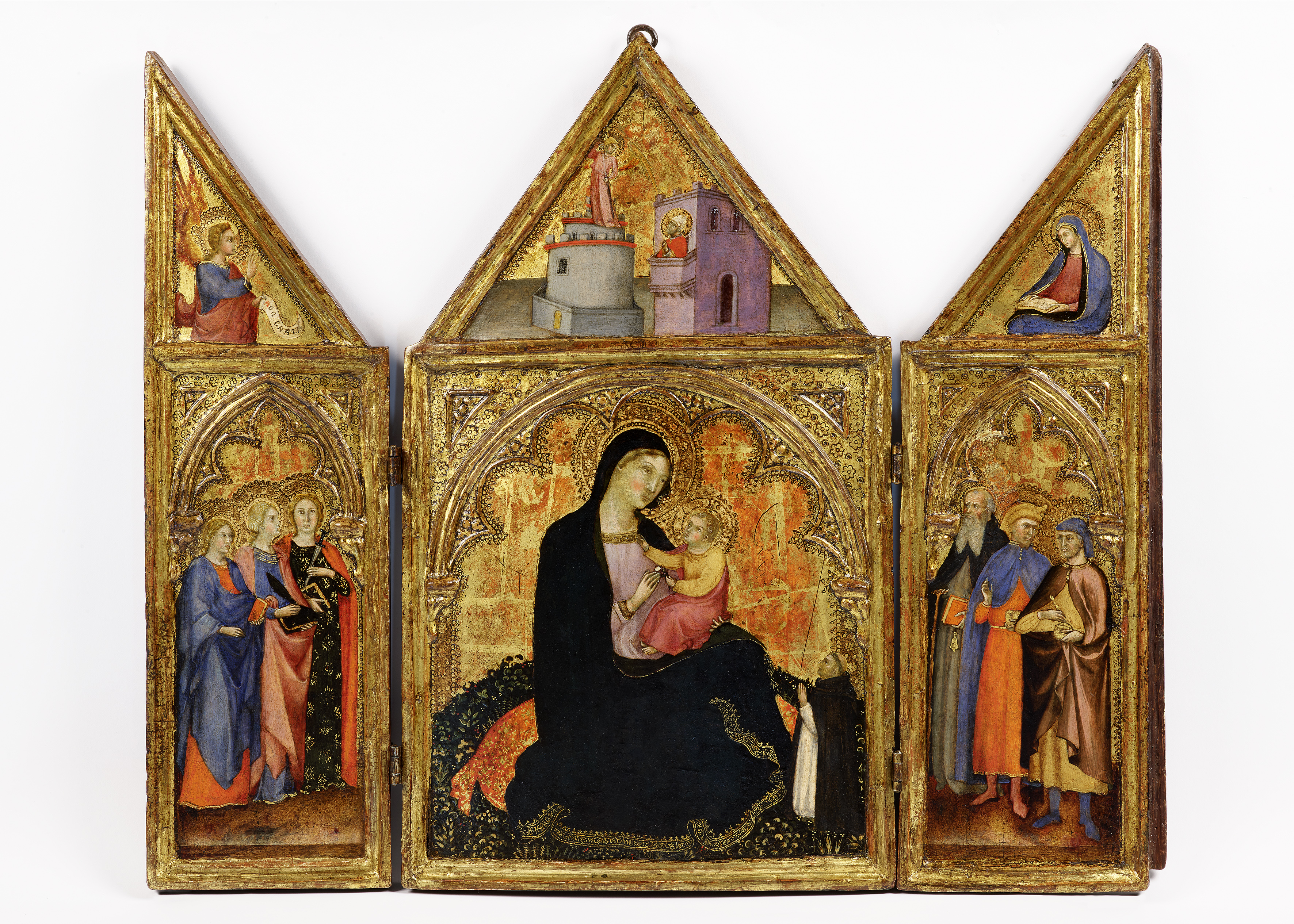
This gold-ground tabernacle triptych is a refined example of a painting intended for private devotion, and its style points to the authorship of Andrea di Bartolo, the most renowned and sought-after painter in Siena in the late fourteenth and early fifteenth centuries¹.
The Madonna of Humility occupies the principal panel. She is seated on a red cushion with elegant gold adornment and surrounded by a meadow with a magnificent and wide-ranging depiction of vegetation, showing the attentiveness to flowers that was a hallmark of late Gothic culture. The Virgin’s cheeks are slightly flushed, like those of her son, and her left hand holds him with tender maternal affection on her lap, which is covered by a long, gold-trimmed blue robe. The Christ Child looks directly at his mother, clutching a small white flower in his left hand. On the right, kneeling on the grass, a Dominican friar raises his hands in prayer, contemplating the apparition of the Virgin and the Son of God.
This presence of the friar indicates that the work was commissioned for a member of the Order of Preachers, with whom Andrea had a close professional relationship². The intended recipient helps to explain the absence of the customary depiction of the blessing Redeemer in the central gable, which is replaced here by a narrative scene, the vision of Saint Gregory the Great, who was particularly venerated by the Dominicans. The subject is taken from Jacopo da Varazze’s immensely popular Legenda Aurea (the Golden Legend, written in the second half of the thirteenth century): there, in the biography of Pope Gregory, an account is given of how he carried a Marian icon in procession through the streets of Rome to ward off a terrible plague during the first year of his papacy in 590. The pontiff’s spiritual journey continued tothe Mausoleum of Hadrian, where an angel appeared to him in the act of sheathing his sword. This was immediately interpreted as a sign that the plague had ended, and in order to commemorate the event, Gregory consecrated the ancient Roman building to the Archangel Michael, giving it its current name of Castel Sant’Angelo.
The wings of the triptych, which function as shutters actoss the central panel, bear images of two groups of saints withexquisitely elegant details such as the gold embellishments on Saint Lucy’s robe, on the left, and the yellow and blue headdresses of Saints Cosmas and Damian, on the right. The pair of gables show the Archangel Gabriel announcing to Mary that she will give birth to the Son of God.
The attribution to Andrea di Bartolo has been confirmed by Stella Sonia Chiodo and Filippo Todini³. In particular, according to the first scholar, the triptych is typical of the artist’s mature work, painted in a style that was by now clearlyfifteenth-century, with a fluid, sinuous handling of line, as in the contours of the Virgin Mary and the saints in the left panel. Among the latter, Saint Lucy displays features that closely resemble those of Mary Magdalene in the Annunciation Altarpiece painted in 1397 for the church of San Domenico in Siena (now in the Museo della Val d’Arbia, Buonconvento; fig. 1). It is precisely this mature style that incorporates elements drawn from the great early fourteenth-century Sienese tradition of the Lorenzetti brothers and Lippo Memmi, but also with special attention to the language of Simone Martini: the fiery wings of the angel in the gable pay direct homage to the style of that illustrious master. Furthermore, in Chiodo’s opinion, the decoration of the meadow on which the Madonna sits reflects the typically Adriatic floral tradition, an element not found in Tuscany prior to Gentile da Fabriano but already present in Venice in Lorenzo Veneziano’s Lion Polyptych of 1362 (Venice, Gallerie dell’Accademia, inv. 10). Andrea may have had occasion to acquaint himself with this figurative tradition during his sojourns in the Veneto, the first before the end of the 1300s, and the second in Treviso between 1424 and 1428.
The creation of small portable altar paintings for private devotion was a recurring feature of Andrea di Bartolo’s career; other examples include the triptychs in the Brooklyn Museum (inv. 34.839) and the Pinacoteca Nazionale in Siena (inv. 153). These foldable objects were designed for domestic interiors and were not necessarily intended to be hung on a wall as simple images. Thanks to their movable structure, they could be carried by their owners to a wide range of places or held in their hands during private prayer. When they were not in use, the shutters could also be closed, taking on a more understated, sober appearance that was typical of domestic environments in convents⁴.
The son of the painter Bartolo di Fredi, Andrea di Bartolo is first documented in 1389, when he is listed in the Breve dell’arte – the regulations governing painters’s professional activity – as collaborating with his father and Luca di Tommè on the now-lost Pala dei Calzolai (altarpiece for the shoemakers’ guild) in Siena Cathedral. Throughout his career, he integrated private and public commissions; his first signed work appears to be the Annunciation Altarpiece (1397), painted for the Basilica of San Domenico. After his activity for a network of Dominican friars in the Veneto at the close of the fourteenth century, Andrea was engaged on painting frescoes in the Chapel of San Vittore in Siena Cathedral between 1405 and 1406; these have not survived. Once again in the cathedral, he carried out the painted decoration of two wooden statues by Francesco di Valdambrino, and in 1407 he left his father’s workshop. Financially well-off, as evidenced by property holdings documented in the 1410s and 1420s, Andrea di Bartolo combined his artistic career with various public appointments. Among his surviving works is the Osservanza Polyptych of 1413, painted for the Sienese convent of Santa Petronilla. After a period working in Treviso between 1424 and 1428, he died in Siena in 1428.
Notes:
1 - Luciano Bellosi, “La ripresa tardogotica in Toscana e a Siena”, in Il gotico a Siena, exhibition catalogue (Siena, Palazzo Pubblico, 24 July – 30 October 1982), ed. by Giovanni Previtali, Florence 1982, p. 293.
2 - Gaudenz Freuler, “Andrea di Bartolo, Fra Tommaso d’Antonio Caffarini, and Sienese Dominicans in Venice”, The Art Bulletin, 69, 1987, pp. 570-586.
3 - Stella Sonia Chiodo, in writing, January 2026; Filippo Todini, orally, April 2026.
4 - Andrea De Marchi, “Oggetti da maneggiare tra sacro e profano”, in Da Jacopo della Quercia a Donatello. Le arti a Siena nel primo Rinascimento, exhibition catalogue (Siena, Santa Maria della Scala, Opera della Metropolitana, Pinacoteca Nazionale, 26 March – 11 July 2010), ed. by Max Seidel, Milan 2010, pp. 356-357.
