


Maestro della tela jeans
(Attivo in Italia del Nord nel tardo XVII secolo)
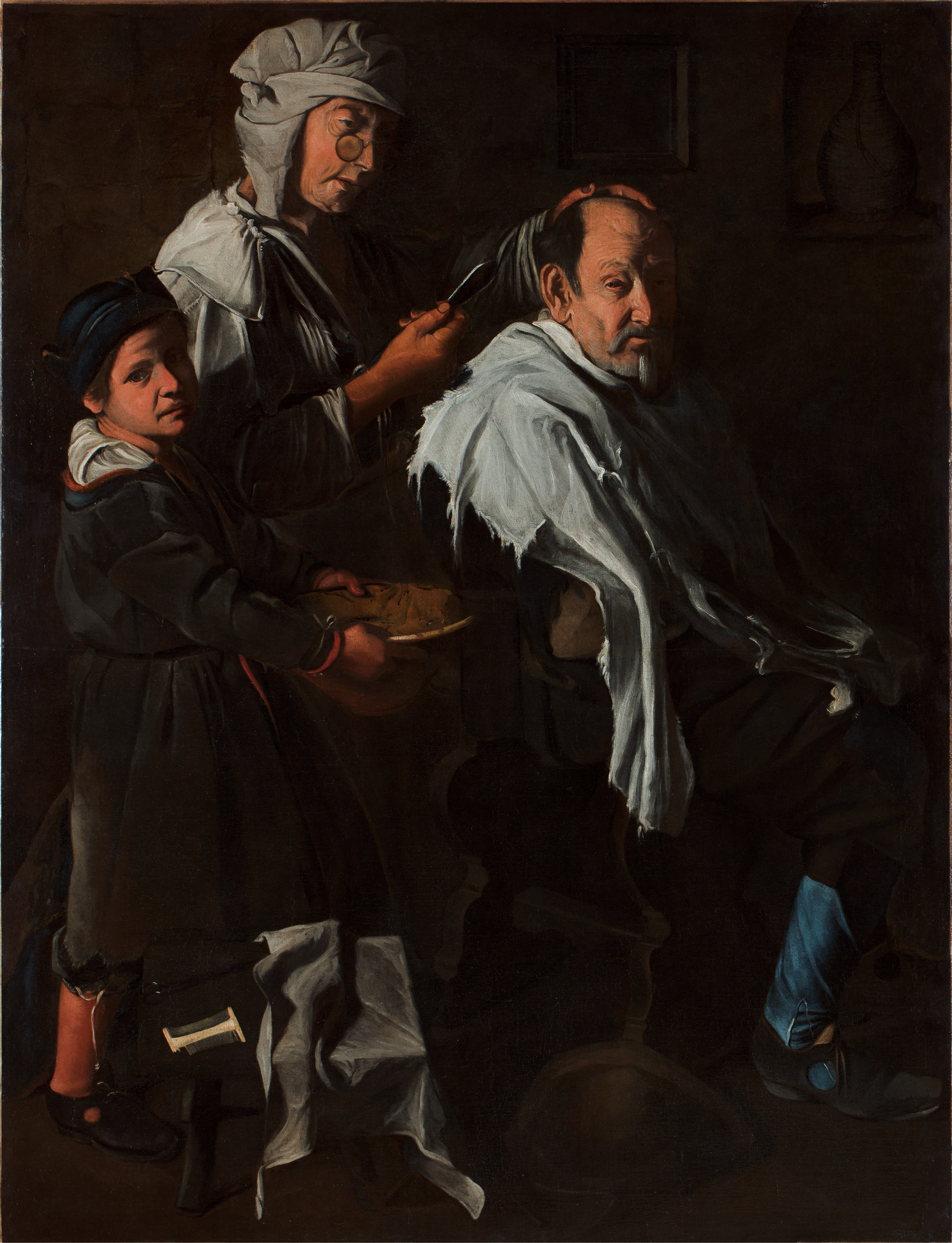
Il BarbiereOlio su tela, 150,5 x 115 cm
- PROVENIENZA
- BIBLIOGRAFIA
- MOSTRE
- DESCRIZIONE




PROVENIENZA
New York, Asta Christie’s del 23 Gennaio 2004, lotto n.6
BIBLIOGRAFIA
- Véronique Damian, Deux tableaux de la collection Sannesi. Tableaux des écoles émilienne et lombarde, Parigi, 2006, pp. 56-59;
- Gerlinde Gruber, Il Maestro della tela jeans: un nuovo pittore della realtà nell’Europa del tardo Seicento, in “Nuovi Studi”, 11, 2006 (2007), pp. 164-165, fig. 248;
- Gerlinde Gruber, in Il Maestro della tela jeans. Un nuovo pittore della realtà nell’Europa della fine del XVII secolo, Parigi, 2010, pp. 50-51, cat. 12;
- Gerlinde Gruber, in Un inedito del Maestro della tela jeans e altre scene del quotidiano, Chiara Naldi (a cura di), catalogo della mostra Lugano, Galleria Canesso Lugano, 2012, pp. 44-47.
- M. Dell’Omo, in Giacomo Francesco Cipper detto il Todeschini. Cronaca e Commedia tra Austria e Italia nel Settecento, Trento, Castello del Buonconsiglio, 12 aprile 2025 – 14 settembre 2025, no. V.7.
MOSTRE
- Il Maestro della tela jeans. Un nuovo pittore della realtà nell’Europa della fine del XVII secolo, Parigi, Galerie Canesso 2010;
- Un inedito del Maestro della tela jeans e altre scene del quotidiano, Lugano, Galleria Canesso Lugano, 2012.
- Giacomo Francesco Cipper detto il Todeschini. Cronaca e Commedia tra Austria e Italia nel Settecento, Trento, Castello del Buonconsiglio, 12 aprile 2025 – 14 settembre 2025.
DESCRIZIONE
Related work:
Another version of this composition is in the Museo Baroffio e del Santuario del Sacro Monte sopra Varese, in Varese, catalogued as School of Giacomo Francesco Cipper, called Todeschini: The Barber, oil on canvas, 146 x 116 cm (inv. 83). Laura Marazzi has informed us that this work very likely comes from the collection of Baron Giuseppe Baroffio Dall’Aglio (Brescia, 1859 – Azzate, Varese, 1929) who left all his goods to the Museo Baroffio e del Santuario del Sacro Monte sopra Varese; the collection was subsequently united with the art collection of the Santuario itself.1
This description of a barber’s shop is representative of the trend for realism that swept through Lombardy with the work of foreign artists such as the Austrian painter Cipper, called Todeschini (1664-1736) or the German Eberhart Keilhau, called Monsù Bernardo (1624-1687). Our picture can be attributed to one of these Northerners active in the Lombard region, a Flemish painter known by the conventional name Maestro della tela jeans (‘Master of the jeans material’), and was presented as such by Gerlinde Gruber at a symposium held in Ljubljana in late 2005, before her publication of a monographic article in 2007.2 Still shrouded in mystery, this master emerged only recently as the author of A Mother Begging with Her Two Children (now in Rancate, Pinacoteca cantonale Giovanni Züst) when the painting was presented in the exhibition on genre scenes held in Brescia in 1998-1999.3 The Züst canvas shows a mother wearing a skirt made of thick royal blue material, the coarsely woven “toile de Gênes” that was to have an enduring legacy as the forerunner of modern blue jeans. This peculiarity provided the still anonymous master with his name.4 In both compositions, he has chosen to present three figures in a pyramidal arrangement that stands out clearly against a dark brown background. The scene in our painting is presented in a manner both touching and harshly truthful, with an old woman busy shaving the beard of a man, no longer young himself. Her left hand rests in an almost familiar way on his head, suggesting she might be his wife rather than an unknown person performing the barber’s task. Her sole assistant is a young boy, who approaches holding a bowl with a chipped side. A small stool, casually covered with a white cloth, serves as a surface for a partly toothless comb and a pair of scissors, while a hat is barely visible on the floor beside it; each object is treated in isolation. The silent gazes and sombre expressions are loaded with resignation and convey as much about the destitute condition of the sitters as the ragged material and threadbare clothes dwelt upon by the painter. The details of the old woman’s eyeglasses, her turbaned head and swollen hands all reflect a direct capturing of reality.
Gerlinde Gruber, who dates our painting to the last quarter of the seventeenth century, has assembled two other works around the canvas in the Züst collection, each displaying the influence of Michael Sweerts (1618-1664), a Flemish painter whose career developed in Rome amid the Bamboccianti.5 Sweerts’ influence on our painter lies less in the fine painting manner of the Flemish tradition than in the use of muted colours, juxtaposed in subtle harmonies of browns, greys, and the cool blue of the man’s stocking, which directly evokes the “tela jeans” of the painter’s nickname.
Since our initial publication and the most recent article by Gerlinde Gruber, a copy of the subject has come to light in the Museo Baroffio, Varese. Slightly smaller in height – it was no doubt cut down – this copy does not reveal any major variant, other than the plain background, whereas our composition has a small niche with a bottle. This is an exciting discovery because it tells us about the artist’s creative process: he did not hesitate to repeat his composition, no doubt to satisfy the needs of collectors.
Notes
1. We are grateful to Gerlinde Gruber for having informed of us of this version. Thanks also go to Laura Marazzi, curator of the Museo Baroffio, for having provided us with a photograph and information relating to this work.
2. Gerlinde Gruber, “Un altro pittore della Realtà”, symposium paper, Flemish and Dutch painters in Central Europe and northern Italy in the late 17th century. Almanach and the Painting of the Second Half of the 17th Century in Carniola, Ljubljana, 21 October 2005; published in greater detail in the recent issue of Nuovi Studi, 2007 (see bibliography).
3. Gerlinde Gruber, in Da Caravaggio a Ceruti. La scena di genere e l’immagine dei pitocchi nella pittura italiana, ed. Francesco Porzio, exh. cat., Brescia, Museo di Santa Giulia, 28 November 1998-28 February 1999, p. 425, no. 90, illus. p. 219.
4. Francesco Frangi, “Dai pitocchi al ‘buon villan’. Metamorfosi della pittura di genere a Milano negli anni di Parini”, in L’amabil rito. Società e cultura nella Milano di Parini, symposium papers, Milan, 1999, ed. G. Barbarisi, C. Capra, F. Degrada, F. Mazzocca, Bologna, 2000, II, pp. 1145-1162.
5. Gerlinde Gruber, “Maestro della tela jeans”, in Dipinti lombardi del Seicento. Collezione Koelliker, ed. Francesco Frangi and Alessandro Morandotti, Turin, 2004, pp. 156-161, with black and white illustrations of A Mother Sewing with Her Two Children (Milan, Fondazione della Cassa di Risparmio delle Province Lombarde) and A Little Beggar Boy with a Piece of Bread (private collection).
