


Master of San Martino alla Palma (?)
active in Florence during the first thirty years of the 14th century
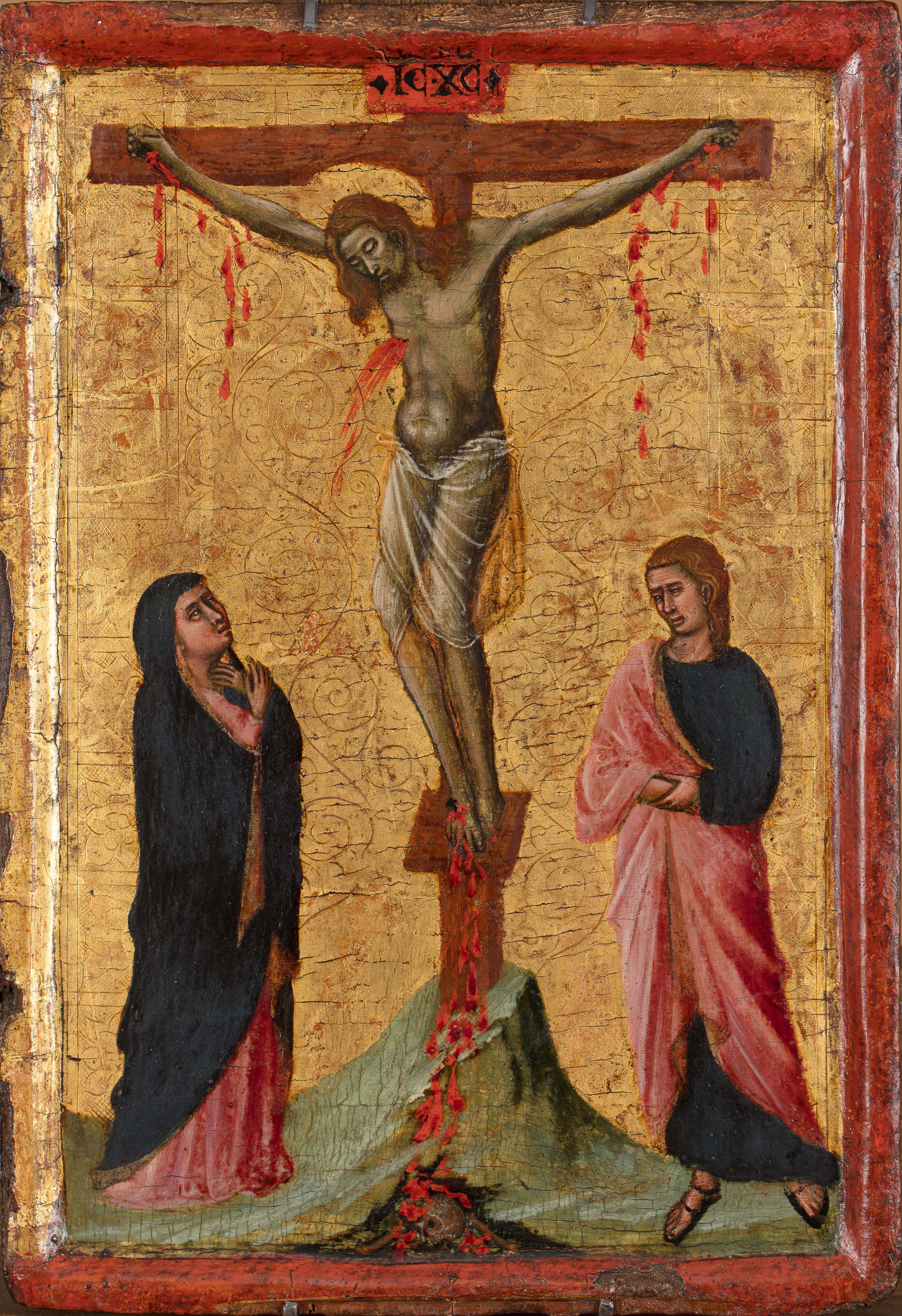
CrucifixionTempera and gold on wood panel, 34 x 23.3 cm (painted surface 30.6 x 20 cm), 1.7 cm thick
- PROVENANCE
- BIBLIOGRAPHIE
- EXPOSITIONS
- DESCRIPTION




PROVENANCE
Lyngby, Denmark, private collection, since 1930; Lugano, Galleria Canesso, since 2024.
DESCRIPTION
This panel, with a depiction of the Crucifixion, was originally the right wing of a diptych, of which iron pieces of the two hinges remain visible on the back, hammered down in typical V-shapes. On the left, there must have been a panel, yet to be discovered, with an image of the Virgin and Child. The gold background was incised freehand with the tip of a stylus, but there is no sign yet of punchmarks, which were also common in Florence between 1320 and 1330. The background is decorated throughout with spiral swirls, still in thirteenth-century style, as found in works by the school of Giunta Pisano and in those of the Umbrian painter known as the Master of San Francesco, and Guido da Siena. The solid corporeal quality seen here connotes the art of Giotto, and the figure of Christ, his head bowed and hair falling forward, depends on that of the grand Cross in Santa Maria Novella, painted by Giotto around 1290, but not in a literal way: this is more pathetic, with the head thrust forward and a copious dripping of blood, the drops almost set like rubies on the densely worked gold. A very dark chiaroscuro, later abandoned by Giotto in favour of more nuanced modulation, was a feature of his earliest works and of one of his early followers, the Master of Santa Cecilia, who may be identifiable as Gaddo Gaddi, the father of Taddeo Gaddi. The artist of this Crucifixion is very close to the Master of Saint Cecilia in his earlier works, for example in the verticality of the figures and the long, rhythmically repeated folds of their robes. Yet the cadence is gentler and more delicate here, with potent sentiment expressed through the intense gaze of the Virgin Mary and John’s clasped hands: the grip on that arm is not merely about volume but emotional tension. This subtle expressiveness, along with multiple detailed parallels, suggests that the painting can be attributed to the early albeit elusive phase of a great, yet still anonymous painter known as the Master of San Martino alla Palma, active in the first thirty years of the fourteenth century, perhaps beginning as early as the end of the 1200s. An illuminating comparison can be made between Christ’s loincloth, with its fine, taut, rhythmically repeated pleats, with a hint of transparency over the tapered thighs, and two characteristic works by the painter, a Crucifixion in the Gemäldegalerie in Berlin and a painted Cross in the Galleria Nazionale dell’Umbria in Perugia.
A significant reflection of the early, proto-Giottesque character of the work (that is, Giottesque in a still emerging, youthful manner) is the back, painted in trompe-l’oeil with the form of a fictive three-lobed lancet window, inlaid with veined marble.
